


Safety Flooring & Matting
- Shelving/Racking & Storage









Find the Right Mat with MatBrain
Answer a few questions about your workplace, floor conditions and application to narrow down suitable matting products from our range.
Safety Flooring & Matting Buying Guide
Workplace matting and safety flooring can support a safer, cleaner and more comfortable working environment. The correct product depends on where it will be used, the type of contamination present, how long people stand in the area and whether the priority is comfort, entrance dirt control, drainage, slip resistance, floor protection or a specialist electrical requirement.
Our range includes anti-fatigue mats, entrance mats, rubber matting, interlocking workplace tiles, anti-slip tapes and GRP strips, electrical safety matting and accessories for warehouses, workshops, production areas, entrances, service counters and commercial premises.
MatBrain is positioned at the top of this page to help you shortlist suitable mats before browsing the range. This guide explains the main choices in more detail and highlights the measurements, floor conditions and workplace risks to consider before ordering.

Shop Safety Flooring & Matting by Product Type
Start with the product family that most closely matches your application, then compare individual specifications for material, surface, resistance, dimensions and intended environment.
Safety Mats
Anti-fatigue, drainage, rubber, electrical and specialist mats for standing workstations and demanding workplace conditions.
View Safety MatsEntrance Mats
Indoor and outdoor entrance matting designed to scrape dirt, capture moisture and support cleaner pedestrian areas.
View Entrance MatsSafety Flooring
Interlocking tiles, anti-slip floor products, tapes and GRP solutions for larger areas, walkways, steps and floor hazards.
View Safety FlooringHow to Choose the Right Workplace Matting
Do not choose a mat from appearance alone. Record the environment, task, contaminants, traffic and required coverage before comparing product specifications.
Define the primary purpose
Decide whether the priority is standing comfort, slip-risk control, drainage, dirt and moisture removal, floor protection, electrical insulation or static control.
Identify the environment
Confirm whether the mat will be used indoors or outdoors and whether the area is normally dry, wet, greasy, oily, dusty or exposed to swarf and debris.
Check liquid and chemical compatibility
Oil, grease, cleaning products and industrial chemicals can affect different materials in different ways. Check the individual resistance data before ordering.
Measure the working area
Measure the usable length and width, allowing for doors, machines, fixed benches, floor joints and pedestrian routes. For modular flooring, plan edges and corners as well.
Consider foot and wheeled traffic
A mat suitable for a fixed standing position may not be appropriate where pallet trucks, trolleys or chairs repeatedly cross the area. Check load and traffic suitability.
Plan edges, drainage and cleaning
Check whether ramped or high-visibility edges are required, where liquid or debris will drain, and how the mat can be lifted, cleaned and dried safely.
Use MatBrain before comparing products manually
MatBrain asks about the workplace environment and intended application, then uses those answers to help narrow the available range. Scroll back to the top of the products to use the selector.
Compare Workplace Matting Types
This table provides a starting point. Always check the individual product specification, test data and intended-use information before purchase.
| Matting type | Best suited to | Key features to check | Important considerations |
|---|---|---|---|
| Anti-fatigue mats | Standing workstations, assembly, packing, counters and benches | Cushioning, surface texture, edge profile, material and resistance | Match the material to dry, wet, oily or chemical conditions; matting is one part of wider ergonomic control |
| Open drainage mats | Wet work areas, food preparation, bars and processes producing swarf or debris | Hole design, drainage route, cleaning access and resistance to contaminants | Liquid and debris still need somewhere safe to go; keep the substrate and mat clean |
| Entrance mats | Doorways, receptions, schools, offices, retail and public buildings | Scraping and wiping performance, indoor or outdoor suitability, backing and capacity | Provide enough walk-off length and maintain the mat before it becomes saturated with moisture or dirt |
| Interlocking floor tiles | Larger workshops, production areas, garages and defined work zones | Tile connection, edge pieces, surface pattern, load suitability and repairability | Plan the full layout, transitions, doors and equipment before calculating quantity |
| Anti-slip tapes and GRP products | Steps, ramps, walkways, decking and localised floor hazards | Grit grade, substrate suitability, indoor or outdoor use, fixing method and visibility | Surface preparation and correct installation are essential to long-term performance |
| Electrical and ESD matting | Electrical work areas or static-sensitive workstations where the specification requires it | Applicable rating, test standard, thickness, accessories and earth connection where relevant | Electrical insulating and ESD products perform different functions and must not be treated as interchangeable |
| Rubber rib and floor-protection matting | Benches, shelves, vehicles, work surfaces and general floor protection | Thickness, roll width, surface profile, cut length and material resistance | Confirm whether the product is primarily for protection, grip, comfort or pedestrian use |
Anti-Fatigue Matting for Standing Work
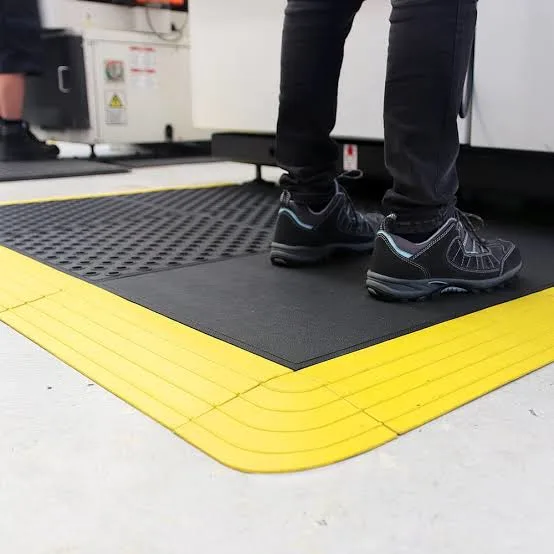
Prolonged standing on a hard floor can contribute to discomfort and lower-limb fatigue. Anti-fatigue matting provides a cushioned surface intended to encourage small postural movements and improve underfoot comfort at fixed standing workstations.
Typical applications
Anti-fatigue matting should form part of a wider approach
A mat does not remove every risk associated with prolonged standing. Consider the complete workstation, footwear, posture, task design, opportunities to change position, seating where appropriate, job rotation and suitable breaks.
Select the mat for the actual environment. A cushioned mat intended for a dry reception or packing bench may not be suitable for oil, grease, cutting fluid, welding debris, aggressive chemicals or frequent wheeled traffic.
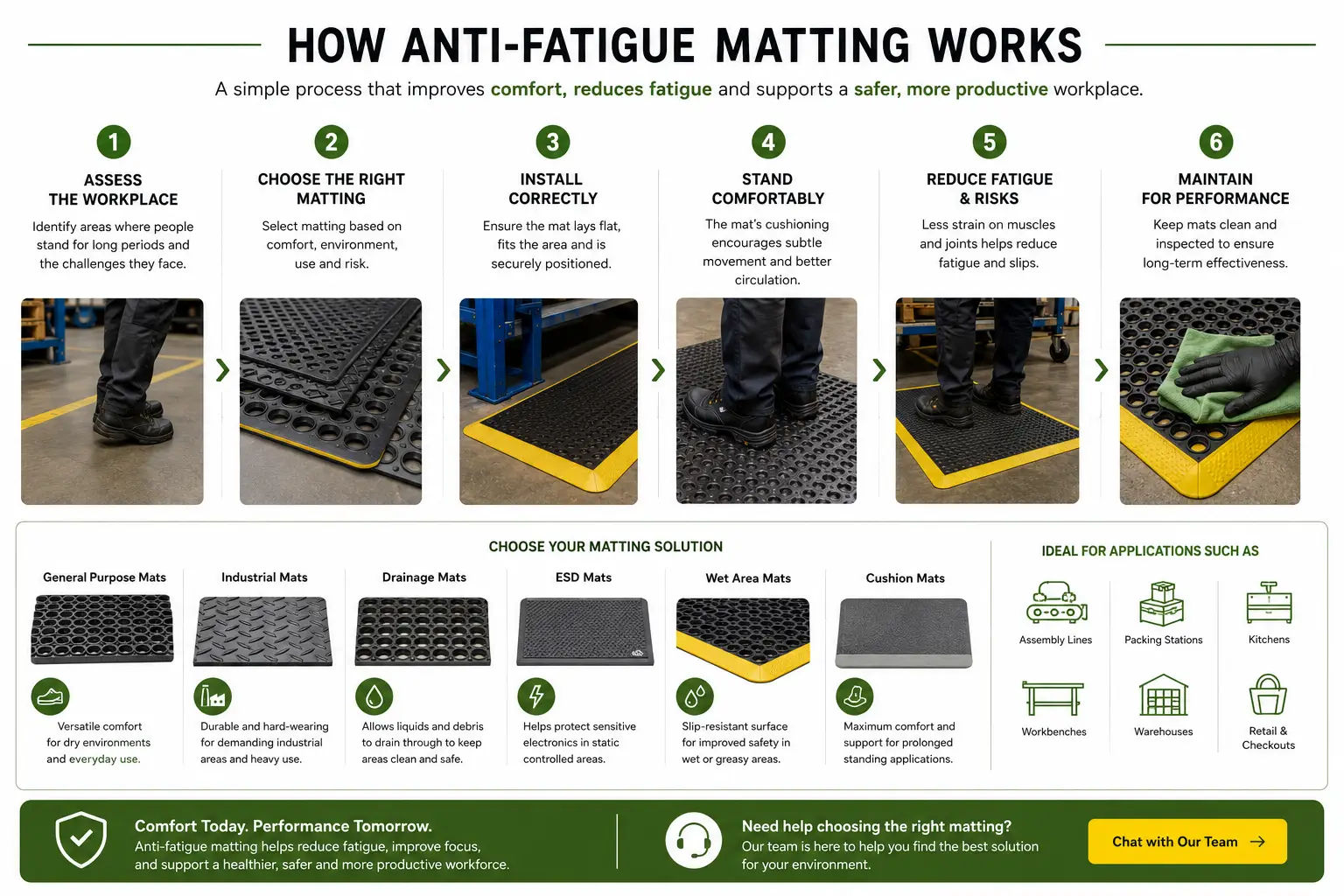
A Practical Matting Selection Journey
Use MatBrain
Describe the workplace and application to identify relevant matting options.
Compare specifications
Check dimensions, materials, resistance, edge options, drainage and cleaning requirements.
Review the business case
For anti-fatigue projects, use the ROI tool and workplace information to support an informed decision.

Choose Matting for the Workplace Condition
The same mat will not suit every floor. Use the conditions below to identify the product characteristics that need closer attention.
Dry standing areas
Prioritise appropriate cushioning, stability, edge design and durability. Confirm whether the mat needs to resist occasional spills or wheeled traffic.
Wet or wash-down areas
Look for drainage, an appropriate slip-resistant surface and material compatibility with water and cleaning products. Plan how liquid beneath the mat will be removed.
Oily or greasy areas
Select a material specifically described as suitable for the oils, grease or process fluids present. General-purpose rubber or foam may deteriorate in incompatible contaminants.
Chemical exposure
Check resistance against the specific chemical and concentration. Product suitability should be assessed using technical data rather than colour or generic product descriptions.
Entrances
Use sufficient scraping and wiping length for the expected footfall and weather exposure. Clean or replace saturated matting before performance is reduced.
Electrical or static-sensitive work
Confirm whether the requirement is electrical insulation or electrostatic discharge control. Check ratings, standards, installation and accessories with a competent person.
Matting does not replace good floor management
Floors should remain suitable for the work activity and foreseeable contamination. Clean spillages promptly, maintain the underlying floor, keep mat edges flat and remove products that have curled, split, moved or become saturated.
Read HSE flooring guidance →Read HSE slips and trips guidance →
Installation Checklist
- 1Inspect the underlying floor and repair defects that could prevent the mat from lying flat.
- 2Clean and dry the installation area using a method suitable for the floor and contaminant.
- 3Position the mat so it covers the working stance without obstructing doors, routes or equipment.
- 4Fit compatible edges, corners, connectors or fixings where specified by the product instructions.
- 5Check transitions from every direction and confirm that the product remains stable during use.
- 6Record the mat within the relevant workplace inspection and cleaning schedule.
Cleaning, Inspection and Replacement
- Follow the manufacturer's cleaning instructions and chemical restrictions.
- Remove dirt, liquid, grease and debris from both the top and underside.
- Allow washed mats to dry fully before returning them to service where required.
- Check for movement, curling, raised corners, splits, worn surfaces and failed connectors.
- Inspect the underlying floor for contamination, damage or trapped moisture.
- Replace the product when damage or deterioration prevents it from remaining stable, cleanable or suitable for the task.
No universal replacement interval applies to every mat. Service life depends on product material, traffic, contamination, cleaning, installation and the workplace environment.
Safety Flooring & Matting FAQs
Which mat should I choose for prolonged standing?
Start with anti-fatigue matting, then match the material and surface to the environment. A dry packing station, oily workshop and wet food-production area may each require a different anti-fatigue product. Use MatBrain and check the individual specification.
Do anti-fatigue mats prevent all discomfort from standing?
No. They can support underfoot comfort and form part of an ergonomic approach, but workstation design, posture, footwear, task variation, seating and breaks may also need to be considered.
Can I use the same mat in dry and oily areas?
Only where the product specification confirms suitability. Oils, grease, chemicals and cleaning agents can affect mat materials, so compatibility should be checked for the actual contaminant.
What size anti-fatigue mat do I need?
Cover the worker's normal standing and movement area without extending unnecessarily into pedestrian or wheeled-traffic routes. For longer workstations, consider modular sections or matting sold by length.
What is the difference between electrical insulating and ESD matting?
Electrical insulating matting is intended to provide a specified level of protection from electrical hazards. ESD matting is designed to control electrostatic discharge around sensitive components. They serve different purposes and should not be substituted for one another.
How much entrance matting is required?
The appropriate length depends on footfall, entrance design and weather exposure. The aim is to provide enough contact for footwear to be scraped and wiped before people move onto the internal floor.
Can trolleys or pallet trucks travel over workplace matting?
Only when the product is suitable for that traffic and installed with appropriate transitions. Soft mats and raised edges can create operational or trip issues, so check the product data and route design first.
How often should workplace mats be inspected?
Inspection frequency should reflect the environment, traffic and consequences of failure. High-traffic, wet, oily or safety-critical areas may require more frequent checks than low-use dry areas.
When should a mat be replaced?
Replace it when wear, curling, splitting, movement, contamination or failed connections mean it no longer lies securely, can no longer be cleaned effectively or is no longer suitable for the intended task.
Need Help Choosing Safety Flooring or Matting?
Tell us where the product will be used, whether the area is dry, wet, oily or chemically exposed, the required dimensions and whether the priority is standing comfort, drainage, entrance protection, floor safety or a specialist electrical application.
Guide reviewed: August 2026 by Premier Storage.